

Tycoon Global 2026 features Northeast’s Contribution and transforming India’s green landscape

Tycoon Global 2026 features Northeast’s Contribution and transforming India’s green landscape
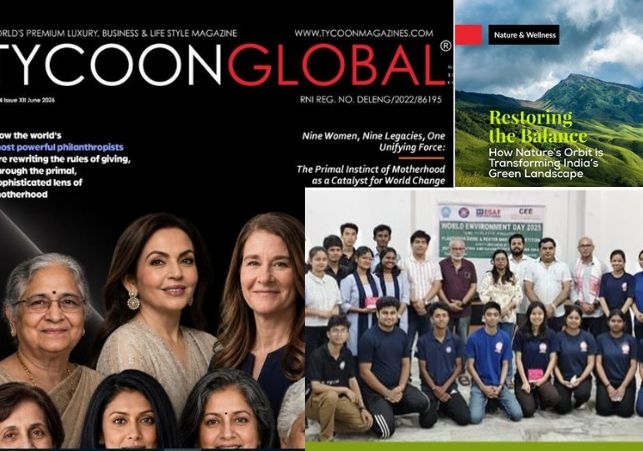
Digital Desk: Northeast has been evolving in many areas in recent years, with the aim of boosting our nature and culture. Recently, Northeast’s contributions to transforming our country’s greenery were featured in Tycoon Global 2026 magazine.
The magazine focused on the journey of Nature's Orbit Solutions Private Limited, which began in Guwahati, Assam, focusing on waste management and environmental degradation through community-driven models. Emphasizing local empowerment over top-down frameworks, the organization partnered with regional bodies like the North Eastern Handlooms and Handicrafts Development Corporation.
Initiatives such as the Har Ghar Tiranga campaign highlighted the integration of economic support and environmental stewardship, benefiting 485 artisan households across Assam, Arunachal Pradesh, Mizoram, and Nagaland.
The makers behind the plan- The leadership of Nature's Orbit, spearheaded by founder and director Debabrata Rajkumar, drives its rapid growth and grassroots initiatives. Rajkumar, committed to creating scalable circular economy models in India, emphasizes reducing the human ecological footprint by converting waste from a liability into a community resource.
Co-directors Pratap Sarmah and Himangshu Kalita focus on corporate governance and project expansion, ensuring robust financial and logistical support as the organization grows. The on-ground transition from theoretical principles to practical applications is spearheaded by project specialists like Barsha Rani and Sashikant, who lead community outreach and educational campaigns.
They connect environmental initiatives with the communities, effectively translating climate concepts into actionable practices, such as collaborating with village artisans and promoting zero-waste habits among corporate volunteers.
Cultivating sustainability through permaculture is central to Nature's Orbit, which promotes an agricultural design philosophy that emulates natural ecosystems. In contrast to monoculture and chemical-based farming, the organization focuses on soil restoration, water conservation, and food security by teaching farmers self-sustaining agricultural systems.
These systems utilize organic waste, employ rainwater harvesting, and advocate for polyculture, reducing reliance on synthetic fertilizers and excessive water. For the team, permaculture transcends farming; it embodies a philosophy guiding their circular economy approach, where every waste product serves as a resource in the system.
Expansion- Nature's Orbit expanded its efforts into Delhi NCR to address environmental sustainability by connecting urban and rural ecosystems. They emphasize experiential education and community engagement through initiatives such as green meetups and climate workshops in collaboration with organizations like UNICEF. Events are hosted in sustainable venues like the mud house Van Bhoj, and multi-day workshops at Dhaam Organic teach permaculture and zero waste living. These programs aim to transform environmental concepts into actionable habits, empowering urban residents to lower their carbon footprints.
Nature's Orbit has established a significant operational base in Jim Corbett National Park, India's oldest tiger reserve, which is under pressure from eco-tourism. The organization offers unique experiential nature retreats and conservation camps for youth and environmental enthusiasts. These programs emphasize zero waste travel etiquette and provide in-depth education on local biodiversity and river ecosystem vulnerabilities. By directly engaging participants in wildlife preservation challenges, Nature's Orbit aims to cultivate a lasting commitment to conservation among tourists.
Future Blueprint- Nature's Orbit exemplifies a holistic approach to environmentalism by connecting artisan communities in Assam, urban youth in Delhi, and wildlife ecosystems in Jim Corbett. Their initiatives provide a scalable model for sustainability in India, focusing on expanding circular economy concepts and increasing eco literacy across the nation. The organization's dedication to community engagement, education, and ecological restoration demonstrates that aligning efforts with the natural order can lead to a sustainable future.